I focus a lot on what youth are facing as well as what their parents & grandparents have done & are doing concerning the technofuture which is mostly hear today already.
Because I am involved in higher education, I tend to concentrate on the academic side of things.In the opinion piece below by Clay Shirky, some sobering data is put forward along with a good analogy between the music industry and the education industry.
I recommend a close read.
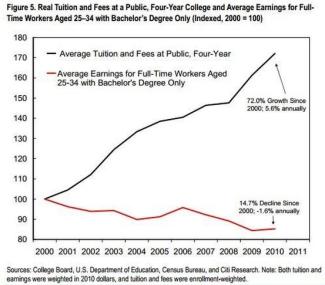
The value of that [college] degree remains high in relative terms, but only because people with bachelor’s degrees have seen their incomes shrink less over the last few years than people who don’t have them. “Give us tens of thousands of dollars and years of your life so you can suffer less than your peers” isn’t much of a proposition. More like a ransom note, really.
This is the background to the entire conversation around higher education: Things that can’t last don’t. This is why MOOCs matter. Not because distance learning is some big new thing or because online lectures are a solution to all our problems, but because they’ve come along at a time when students and parents are willing to ask themselves, “Isn’t there some other way to do this?”
MOOCs are a lightning strike on a rotten tree. Most stories have focused on the lightning, on MOOCs as the flashy new thing. I want to talk about the tree.
via How to Save College | The Awl.
Related articles
- Lightning Hitting a Rotten Tree? (laf.ee)
- If MOOCs are the answer, what is the question? (hastac.org)
- Guide to MOOCs: Free, Quality Higher Education (learningwithtechs.wordpress.com)
- University of Wisconsin System draws attention for competency based online degrees (jsonline.com)
- Weekly Ed-Tech / Digital Scholarship Trends: February 6th, 2013 (eduhacker.net)


 CALL ME MAGGIE
Leave a comment