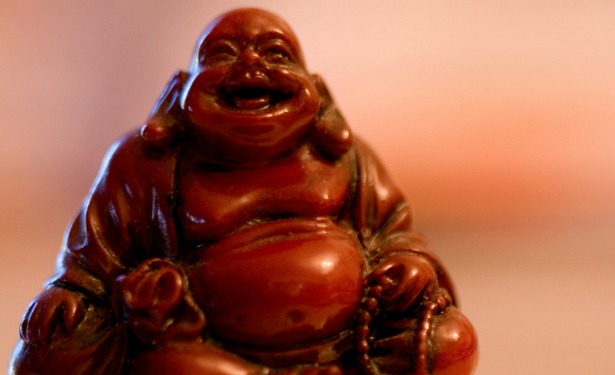
And so was the laughing Buddha!
A piece from the Atlantic sent to me by my good brother Griffen R.
This is a companion piece to two other reblogs: Obviously it expands on the shorter Economist article I reblogged early this morning. But it is wrtten by Emily Esfahan Smith who mentions here an article of hers I reblogged a few months back: There’s More to Life than Being Happy. You might take a look at the second piece before reading this one.
The new PNAS study also sheds light on the difference between meaning and happiness, but on the biological level. Barbara Fredrickson, a psychological researcher who specializes in positive emotions at the University of North Carolina-Chapel Hill, and Steve Cole, a genetics and psychiatric researcher at UCLA, examined the self-reported levels of happiness and meaning in 80 research subjects.
Meaning was defined as an orientation to something bigger than the self.
Happiness was defined, as in the earlier study, by feeling good. The researchers measured happiness by asking subjects questions like “How often did you feel happy?” “How often did you feel interested in life?” and “How often did you feel satisfied?” The more strongly people endorsed these measures of “hedonic well-being,” or pleasure, the higher they scored on happiness.
Meaning was defined as an orientation to something bigger than the self. They measured meaning by asking questions like “How often did you feel that your life has a sense of direction or meaning to it?”, “How often did you feel that you had something to contribute to society?”, and “How often did you feel that you belonged to a community/social group?” The more people endorsed these measures of “eudaimonic well-being” — or, simply put, virtue — the more meaning they felt in life.
via Meaning Is Healthier Than Happiness – Emily Esfahani Smith – The Atlantic.


 CALL ME MAGGIE
Leave a comment