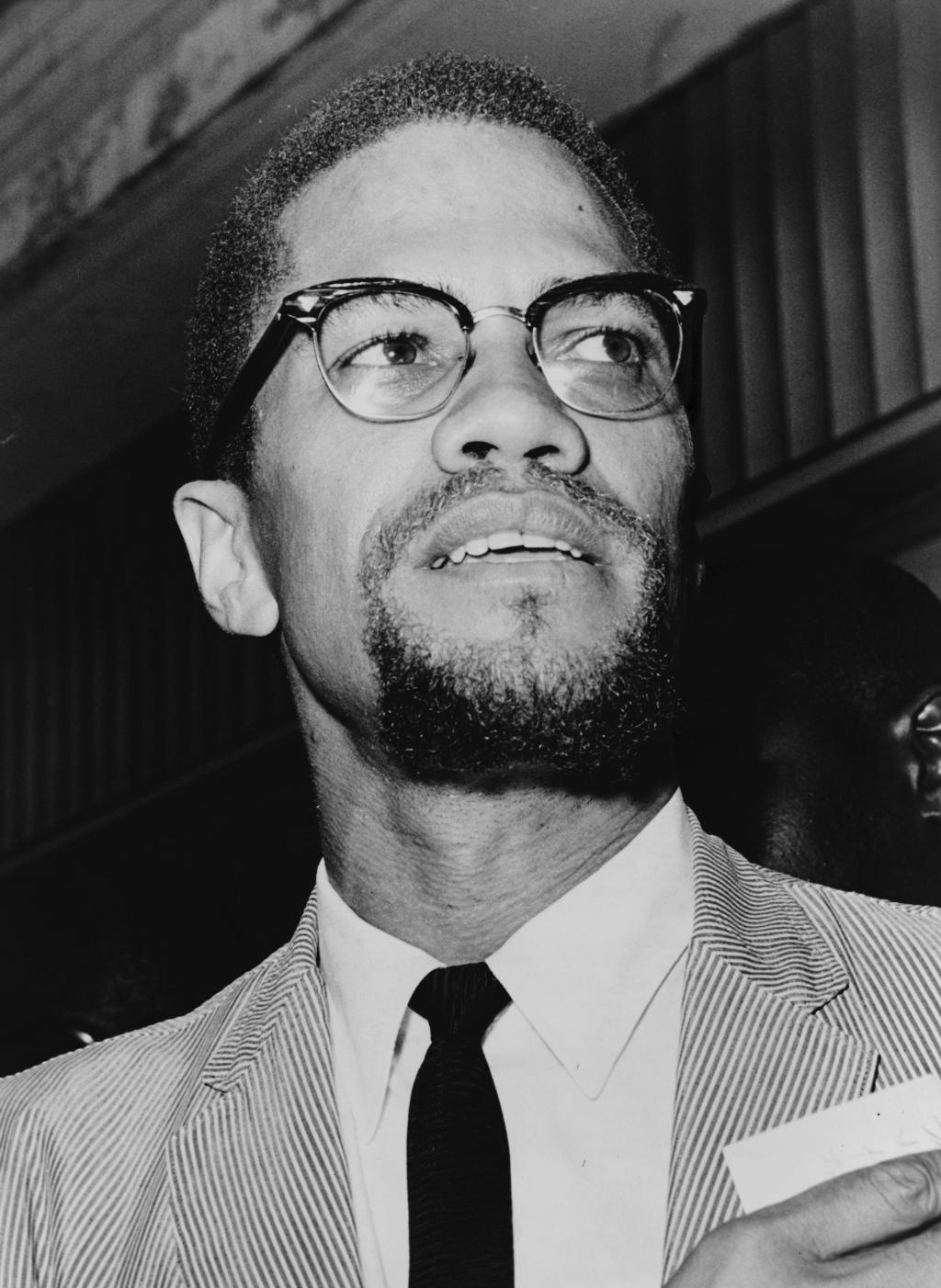
As we situate ourselves to deal with this question through the thinking of Malcolm X, we will have to develop some abstract understandings of several terms: violence vs. nonviolence, resistance, and something that approximates the right (or perhaps the necessity) to resist regimes of oppression, whether they be state-sanctioned or not.
Abstractly, Malcolm X insists upon a very careful, what I will call a “distinct-indistinction,” between violence and nonviolence as forms of resistance on the part of oppressed subjects. Broadly, he forces us to realize that as far as systems of power are concerned, any activity that is designed to destabilize structures of power are deemed “violent.” Meaning that all technologies of resistance — say, for instance, speech acts against a regime — are reacted to, or at least categorized, in the same manner as an armed insurgency. This means that as a practical matter, the telos [or end goal] of any form of protest — let’s use the term “disruptive activity” — will almost universally first be characterized as violent and then reacted to in violent fashion. That is, the abstraction I referenced above that needs to be further glossed as also distinct from acts of self-defense against violence which Malcolm X understands as required to be violent. That abstraction allows us to deal with the specificity of your question that I take to situate, and I believe this to be correct, the plight of Palestinians as inextricably related to the denial of liberty to Black people in this country.
That linkage is, in my estimation, one of the foundational advances provided by the philosophical system (if you will allow me that) Malcolm X developed in that he understands “Black” to reference aggrieved subjects wherever and whoever they might be; a form of global transnational and trans-subjective Blackness.
What that means, returning to the abstraction developed above, is that resistance to the occupation of Gaza or the West Bank by anyone will necessarily be seen as violent by the state of Israel. And I want to take care to acknowledge that there are actors within that government who do not subscribe to this view, and are reacted to violently. That means that a terror attack like that on October 7 by Hamas and others will be understood as a kind of capstone in a logic of violence, whether individual acts in that chain of events can be characterized as violent or not. What this seems to assert is that the answer to the totality of your question regarding what is to be done to effectively oppose systems of state-sanctioned oppression is to mount a structural/systemic response to the structural/systemic refraction of all protest into acts of violence that necessarily tend to blur and, at the same time, magnify actual acts of violence. What Malcolm X endeavors to do through his transnational and trans-subjective understanding of Black(ness) was to create a type of super-citizenship that enjoyed the protection of recognized states for those situated within crucibles of oppression wherever that might be. This becomes Black Panther Party orthodoxy in that oppressed African Americans were deemed to be substantively existing in colonies and therefore colonized. Here, “super” is in great measure meant to be something like “greater than” but also shorthand for “superseding” in that it is an overarching understanding that invalidates typologies of citizenship that are designed only to render subjects objects in terms of the law: acted upon rather than protected by. This would be the kinetic realization of the dormant or potential power of the United Nations Universal Declaration of Human Rights and other prohibitions against apartheid, etc. Aggrieved parties would have the ability, or more accurately already be understood to be protected and if necessary, dynamically so by international peace-keepers dedicated to a realization of the term “liberty” that hovers over this discussion. We are disconcertingly far from realizing that goal.
Source: What Would Malcolm X Say About Gaza and Black Resistance in the US Today? | Truthout


 CALL ME MAGGIE
Leave a comment