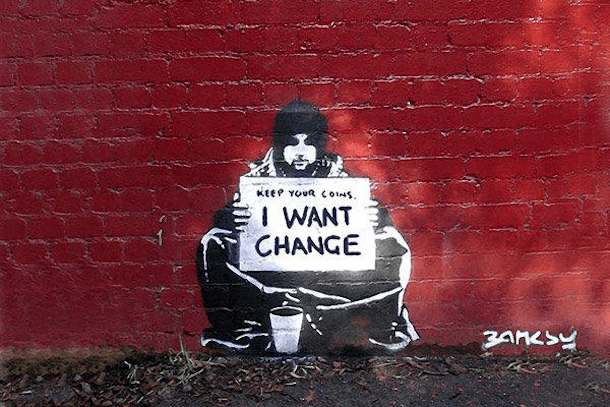
Poverty has become a suburban phenomenon. That should not be a great surprise if you have been paying attention over the last forty years. But there is the rub: most are not paying attention.
Even as professionals become poorer and poorer, not knowing where to turn even when they have degrees in the “right” fields from the “best” schools, tradesfolk and service workers find the world even more unkind. YET… those who are white and poor still ally themselves with Powers-that-Be.
“Things will get better if I let the successful folks drive the economy. I’ll get what trickles down–and They look out for Our interests. Somebody has to stop the black and the brown, the urban and the foreign, from taking our jobs!”
This is not something I have heard from rednecks. This is something I have heard A LOT from folks who are suburban office workers with college educations.
Solidarity requires that we recognize the real issue at the heart of our society. Rather than being separated by the traditions of racism–even as they still haunt us–we should be united by the reality of poverty.
Poverty keeps a disproportionate group of black and brown Americans beyond a flourishing life. Poverty also keeps a growing mass of white people compliant with the system.
Poverty and its specter are the commonality that make the overwhelming majority of us utterly insecure.
The majority of white people need face facts: allegiance to the Powers-that-Be does not serve your interests anymore than it serves the interests of black or brown Americans.
Stereotypes serve as cognitive short-cuts which the viewer, and we as a society, use to categorize and evaluate the relative worth of whole groups of people. The way that images of white, “poor”, female, “overweight”, “unattractive”, bodies are processed by the viewer is a reflection of how we as a society think about race, class, and gender. These concepts exist individually while also having meaning in relation to one another.
Moreover, in America, because of the Calvinist-Horatio Alger-Myth of Individualism and Upward Mobility, claims on poverty necessarily involve moral judgments.
The black single mother is a “welfare queen” who is “lazy” and has “bad morals”. The poor white person is a “redneck” or a “hillbilly” with all of the stereotypes and assumptions implicit in such language.


 CALL ME MAGGIE
Leave a reply to Kyle Simmons (@OneCarlNorman) Cancel reply