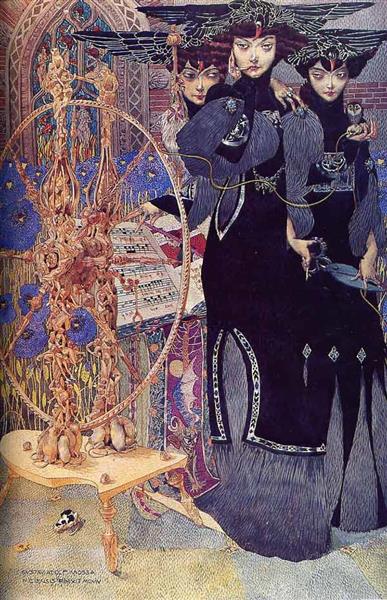
‘Q’ then, will never be a coherent letter tacked as a bridge on some list of identities. The past decade shows the poverty or ruin of every attempt to do so. We’ve said already that these words are magic. We might add that they are wyrd – the Old English for fate and all the other invisible and nonlinear causalities we are woven into and which gives us the modern word ‘weird’. The queerest insurrection demands the weirdest, the most enmeshed in the unseen, the most in relationship with all that teems just beyond the normative filter we are still fighting to unlearn. Find those who straddle that filter, a foot in each world. Share your methods, share what you’ve learned, share the stories of your dead. The dead we hold in common make us family – some other form of kinship than the Norm and its terror. We need each other today more than ever. We want to win this time, to win all the time, and the dead want that too.
Mary Nardini Gang. 2018. Be Gay Do Crime. San Francisco: Contagion Press.
Rather than thinking of existential elucidation (Jaspers 1970b) as queering Existenz, consider the disclosure of possible Existenz always already as Wyrding.
When I began my dissertating journey last year, I had no idea how much queer theory and the methods of queering would become a big part of my work. I should not have been surprised by this, I suppose. After all, I wanted to write about playfulness and Tarot because of my own path: How I transformed from a quietly closeted child to an open out-spoken adult.
I have read and made use of queer theory (QT) for a long time. Despite this, I never referred to myself as a queer theorist per se. Over the last few months, I have completed a few projects. These projects involved applying QT to topics I was exploring. These topics included queering Tarot, queering resistance, and queering Dasein. This approach helped me fully understand my discoveries. I explored these discoveries among influential figures like Foucault, Sedgwick, Butler, Hall, and O’Rourke. This work has been very productive. However, it doesn’t align with how I should discuss the significance of hermeneutic playfulness.
The terminology and the methodology of QT have become fairly set. QT has specific parameters within the Academy. It has also been used with some success since the 90’s. It has advocated for identities that were previously silenced in society at large. After integrating more QT into my thinkering, I realize something. I see that the AnarchoCynic phenomenology I will be doing is not precisely…
Queering: The method in queer theory that analyzes socio-cultural texts to reveal how biases from heteronormativity are often overlooked, making harmful sexual and gender binaries seem “natural.”
I have to thank my advisors for this realization. When I made my prospectus pitch to my dissertation committee,1 they all gave helpful feedback for getting underway as well as staying on course. One issue of concern they shared with me centered on my claim that “everyone is queer.”
Initially, I argued how the framework of Existenzphilosophie (Jaspers 1970a,b,c) presents each person as a singular nexus of possibilities. It does not merely display them as one example of a human type. Of course, our adoption of static definitions of self and cultural notions of essence have a certain utility. We don’t have to keep meeting each other all over again, for instance. Such practices make everyone feel more familiar with each other. We are not totally identical. However, we are not very different either. At its best, this position offers a liberal presumption. The superficial differences between me and you are not as important as the underlying substance of our humanity. At its worst, such presentations lead to careless conservative presumptions. These presumptions suggest that folx who appear different really should not live together in the same society.
I affirm the work of Jaspers, de Beauvoir, Ortega y Gasset and many others. Thus, I deny that human beings have a fixed “nature” (essence) other than the freedom inherent as authentic possibility (Existenz). The appearance of difference–not the imposition of categorical identity–points to our ontological truth.
We do not go straightly-toward each other so much as we move queerly-froward. Recognizing this to-and-fro can allow for some intriguing exchanges. This happens only when the dialectical tension ultimately resolves itself in a new thinkering. Otherwise, the “fro” will slowly slip back into the gravity well of “to,” merely tolerated as an oddity.
Prof. Rowe made a good argument that I should take-care putting too much emphasis on this. My queer comrades and I struggle in a public sphere where many take refuge in self-identifying in a particular way. We endure hardships within institutional associations. These associations require queering to reactivate the history of QUILTBAGs.2 This rich story has been misinterpreted, straight-washed, or outright erased from public view. In that environment, to refer to everyone as “queer” might start a process of appropriation. Many well-meaning, a few lazy, and some nasty folx might claim “queerness” for themselves. They could go straight to “colonizing” queer identities and safe spaces. Obviously, this dis-empowers what little security queer folx have been able to eek out in our current political climate.
Within QT, there are lots of different mind-walkers already seeing some slippage toward institutional appropriation.3 Not just by corporations and local businesses committing themselves to rainbow campaigns. Not even by “progressive” politicians seeking to broaden their base by being an “ally” to queer folx. Rather, among academics “applying” QT and thereby accomplishing a disciplinary capture that often debilitates the real political radicality of queering. As Halperin notes, it has become “…an unproblematic, substantive designation for a determinate field of academic practice, respectable enough to appear in advertisements for academic jobs and in labels on the shelves of bookstores…” (1995: 113).
Taking this into consideration, I adopted my own AnarchoCynic direction for post-queer struggle.4 It made sense to seek out another way of thinkering. This new way might offer a synthesis that shakes off dualistic categories. I have followed many paths on my life-quest. I have never made much more than tacit use in my academic work of one particular idea:
Wyrding: Discovering our ownmost path as a singular threading-of-will within the always-already unfolding fabric of reality.
I read Beowulf for the first time in 1993. I was surprised to learn that the etymology of “weird” goes back to the Old English term for Fate: WYRD.5 I used to say to folx when they would call something weird, “Well, weird is just the Old English notion of Fate. So, maybe–if this is weird–there must be something really important going on.” Usually this would get a chuckle or shrug. I was being seriously playful.
Obviously over time, weird has changed from meaning unnatural or supernatural in some grand sense. For example, Frankenstein’s creature is weird. Now, it just means odd or off from the everyday. For instance, it’s weird that Starbucks was out of iced cold brew. Words of great gravity lose weight over time.
Wyrd reconsiders the meaning of destiny not as a forever-fixed doom. Instead, it is a patterning–material and spiritual. This patterning requires playful engagement to-do-Self-becoming. It is very much an Anglo-Saxon parallel to concepts like Dào or Kismet or Karma. These themselves are not reduced to immutable doom for the actor.6
Some might think I am appropriating neo-pagan thinkering instead of queerness. Nonetheless, this is an important part of my belief system. It also differs from the socio-political identity used by queer folx.
I will continue mind-walking this path over the next few weeks before I begin teaching in the second summer session. So stay tuned for more.
Next up: Wyrding as Dialogical Becoming
BIBLIOGRAPHY
Bates, B. 1983. The Way of Wyrd: Tales of an Anglo-Saxon sorcerer. London: Arrow Books.
Butler, J. 1993. Bodies that matter: On the discursive limits of “sex.” New York: Routledge.
Hall, D. E. 2009. Reading sexualities: Hermeneutic theory and the future of queer studies. New York: Routledge.
Halperin, D. M. 1995. Saint Foucault: Towards a gay hagiography. New York: Oxford Univ Press.
Huffer, L. 2011. Mad for Foucault: Rethinking the foundations of queer theory. New York: Columbia Univ Press.
Jaspers, K. 1970a. Philosophy, Vol 1: Philosophical world orientation. Trans. E. B. Ashton. Chicago: Univ of Chicago Press.
___. 1970b. Philosophy, Vol 2: Existential elucidation. Trans. E. B. Ashton. Chicago: Univ of Chicago Press.
___. 1970c. Philosophy, Vol 3: Metaphysics. Trans. E. B. Ashton. Chicago: Univ of Chicago Press.
Mary Nardini Gang. 2018. Be Gay Do Crime. San Francisco: Contagion Press.
Kollias, H. 2012. Queering it right, getting it wrong. Paragraph, 35 (2): 144-63.
O’Rourke, M. 2014. The Afterlives of queer theory. International Social Science Journal, 63(207-208), 25-37.
Ruffolo, D. V. 2009. Post-Queer Politics. Burlington, VT: Ashgate.
Sedgwick, E. K. 2008. Epistemology of the Closet. Berkley, CA: Univ of California Press.
- Adam Briggle (director, UNT Philosophy & Religion); Terra Rowe (member from UNT Philosophy & Religion); and Tyson Lewis (member from UNT Art History, Art Education) ↩︎
- Queer/Questioning, Undecided, Intersex, Lesbian, Transgender, Bisexual, Asexual, Gay. ↩︎
- Halperin 1995; Hall 2009; Ruffolo 2009; Huffer 2010; O’Rourke 2014; Mary Guardini Gang 2018. ↩︎
- Ruffolo 2009. ↩︎
- It derives from the name of one of the Norns, the Norse goddesses of fate: https://en.wikipedia.org/wiki/Urðr ↩︎
- Bates 1983: 12. ↩︎


 CALL ME MAGGIE
Leave a reply to Keith “Maggie” Brown Cancel reply