1. The Double Anachronism Problem
I’ve been wrestling with a peculiar historical puzzle while developing ideas for a Modern European Philosophy course. The standard label for the period from roughly 1600-1800—”the Scientific Revolution”—contains not one but two fundamental anachronisms that distort how we understand early modern thought.
The first anachronism, which I’ve discussed often with colleagues, concerns the word “science” itself. The modern disciplinary conception of science, complete with professional scientists working in specialized fields, is a 19th-century invention (thank you, William Whewell, for coining “scientist” in the 1830s). Early modern thinkers understood themselves as natural philosophers and moral philosophers, not scientists.
But the second anachronism is even stranger, and it’s sent me down a rabbit hole through Hannah Arendt’s On Revolution that I want to share with you.
2. The Heavenly Origins of Revolution
Here’s what fascinates me: the term revolutio, which we now associate with violent political rupture and the birth of radically new orders, originally meant precisely the opposite: i.e. Lawful recurrence, cyclical restoration, eternal return.
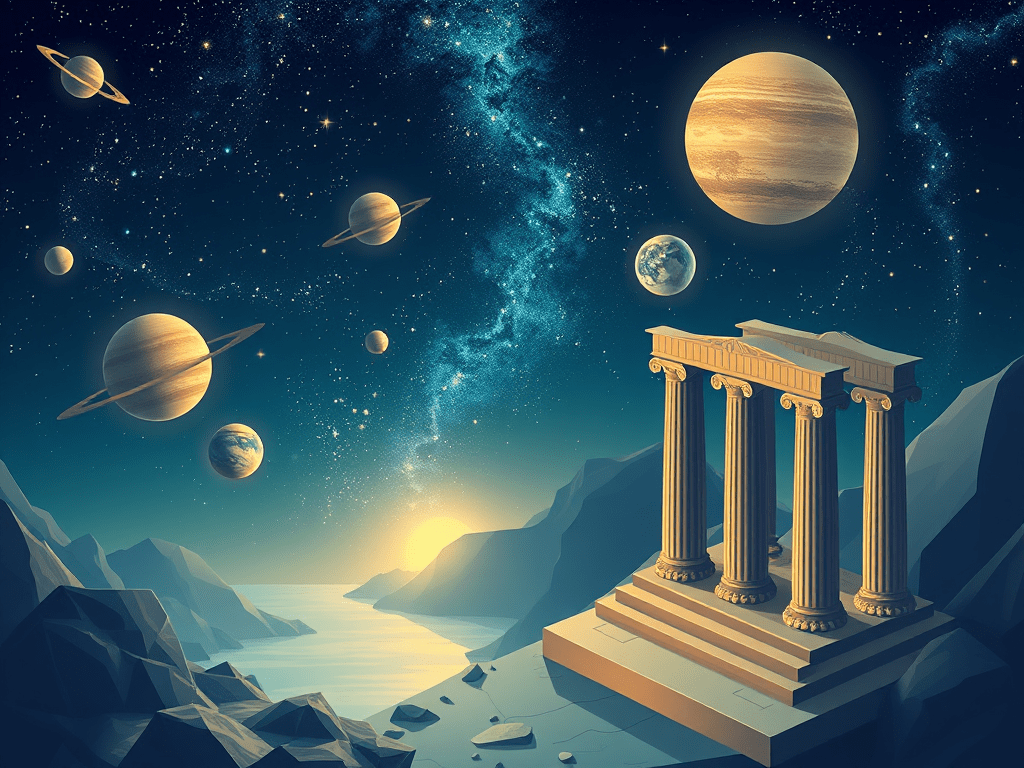
The word comes to political language from astronomy, specifically from Copernicus’s De revolutionibus orbium coelestium (On the Revolutions of the Heavenly Spheres, 1543). In this astronomical usage, revolutio retained its precise Latin meaning: the regular, lawful, revolving motion of the stars. The heavens revolve. They complete their circuits and return to their starting points in predictable cycles. There is no violence here, no rupture, no novelty—only the eternal dance of celestial mechanics.
When Polybius used the Greek term anakyklosis (ἀνακύκλωσις)—which Hanah Arendt tells us is the perfect Greek equivalent of the Latin revolutio—he applied this astronomical metaphor to politics. Just as the stars follow their ordained paths, cycling through the heavens, so too do governments cycle through their forms: monarchy decays into tyranny, aristocracy into oligarchy, democracy into mob rule, which then circles back around to monarchy again. This is the constitutional cycle Plato describes in Book VIII of the Republic—a perpetual rotation through governmental forms, driven by the same irresistible necessity that governs the motions of the planets.
The crucial point: Revolution originally named eternal return of the same.
3. The First Political “Revolution”: Restoration, Not Rupture
This is where Arendt’s analysis becomes most revelatory. She elucidates the word “revolution” as first entering political vocabulary in the 17th century as meaning exactly what its astronomical origins suggested: a turning-back (L. volvere [turn, roll] + re– [back]) to proper order, a restoration of legitimate authority.
Given the importance of the Civil War in England (1642-1651) on much political language for English speakers ever since, nobody would be surprised to see it spoken of in terms of a violent overthrow of the established order. Nonetheless, revolutio was first deployed politically not during Cromwell’s rise to power, even if today this is a “turn” some probably would call “revolutionary dictatorship.” The Civil War gave way to Oliver Cromwell’s “Lord Protectorate” after the Puritan armies of the House of Commons defeated the King and his lords of the Royalist alliance. However, this parliamentary government officially described itself as a having brought things back into proper order. The 1651 inscription on the reworked great seal of the Commonwealth read “… freedom by God’s blessing restored.” So, even what has been recognized as revolutionary dictatorship understood itself in restorationist terms.
In 1660, the Stuart dynasty returned on the death of the man who ordered King Charles I beheaded. Here is where the term comes into English political usage in 1660 at the Restoration of the monarchy after the overthrow of the Rump Parliament. The return of Charles II was called a “revolution” precisely because it represented a revolving back to rightful monarchical government, a restoration of the natural political order that the Puritan cleansing had temporarily disrupted from the natural course of things.
Similarly, the Glorious Revolution of 1688, which expelled James II Stuart with no shedding of blood, transferred power to his eldest daughter Mary II and his son=in-law William III of Orange. This was understood by its participants as a restoration of monarchical power to “its former righteousness and glory,” not as the creation of something new.
In all these instances, the actors themselves believed they were returning to an older, truer order, not forging a novel one.
4. The American and French Revolutions: Restoration or Creation?
Here’s where it gets really interesting, and where Arendt’s argument becomes most provocative: even the American and French revolutionaries, the very people who gave us our modern understanding of “revolution,” initially saw themselves as engaged in acts of restoration, not creation.
The American colonists believed they were defending ancient English liberties against monarchical tyranny, returning to constitutional principles that George III had violated. Benjamin Franklin could write in all sincerity that he had “never had heard in any Conversation from any Person drunk or sober, the least Expression of a wish for a Separation.” They were reclaiming rights, not inventing them. Even the language of “independence” was late to arrive; the movement began as an effort to restore proper colonial-metropolitan relations.
In France, Tocqueville observed that “one might have believed the aim of the coming revolution was not the overthrow of the old regime but its restoration.” The revolutionaries saw themselves as sweeping away the corruptions and tyrannies of recent centuries to recover something more authentic—whether ancient Gallic liberties, Roman republican virtue, or natural rights that had been buried under monarchical despotism.
Thomas Paine—that most “revolutionary” of men—actually proposed calling these upheavals “counter-revolutions,” wanting to preserve the old astronomical meaning: i.e. humanity was revolving back to an “early period” when it possessed rights and liberties of which “tyranny and conquest had dispossessed them.”
As happens with a deep dive into well-documented history, the irony is almost unbearable: Paine and Burke, bitter opponents on almost everything, agreed on this fundamental point. Both believed that absolute novelty would count against, not for, the legitimacy of political claims. Rights had to be ancient, grounded in tradition, recovered rather than invented. Burke defended the customary rights of Englishmen; Paine insisted the rights of man were equally traditional, just more deeply buried. But neither imagined they were creating something unprecedented.
5. When Did Revolution Become Revolutionary?
So when and how did “revolution” transform from restoration-as-eternal-return into rupture-as-absolute-beginning?
Arendt identifies the precise moment with cinematic clarity: the night of July 14, 1789, in Paris, when Louis XVI learned of the fall of the Bastille. The famous exchange goes:
Louis XVI: “C’est une révolte” (This is a revolt)
Duc de La Rochefoucauld-Liancourt: “Non, Sire, c’est une révolution” (No, Sire, it is a revolution)
In this brief dialogue, we hear the word shift meanings before our ears. The king says revolt—a rebellion, a disturbance he can suppress with his available powers. The duke corrects him: revolution—something irrevocable, beyond the king’s power to arrest.
But pay close attention to this: Liancourt yet still invokes the astronomical metaphor.. The motion is still understood through the image of celestial movements. What’s stressed now, however, is not the cyclical return but the irresistibility. Just as no human power can arrest the motion of the stars, so too the events now unfolding are beyond the king’s ability to control or reverse.
The old metaphor remains; however, the emphasis has shifted catastrophically. The revolution is still like the stars. Nonetheless, now we emphasize that the stars are irresistible, not that they recur.
5. The Stream That Devours Its Children
Once the revolution was understood as an irresistible force rather than a cyclical return, new metaphors proliferated—all emphasizing motion, momentum, necessity. The revolutionaries themselves coined these images:
- Robespierre’s “revolutionary tempest” (tempête révolutionnaire)
- The “march of the Revolution” (marche de la Révolution)
- Georg Forster’s “majestic lava stream of the revolution which spares nothing and which nobody can arrest”
- Vergniaud’s haunting phrase: “The revolution devours its own children”
These are no longer astronomical metaphors of lawful cycles. They’re geological, meteorological—images of irresistible natural forces that sweep everything before them. The revolution becomes a torrent, a current, a storm. Something that began with human agency transforms into something superhuman, autonomous, unstoppable.
Hegel, watching these events, saw in them a new kind of historical necessity—the reconciliation of heaven and earth, the descent of cosmic lawfulness into human affairs. The “irresistible movement of the heavenly bodies” had somehow transferred its necessity to political history. Freedom and necessity became dialectically identical. What began as human actors asserting their liberty ended as impersonal forces determining their fate.
By the 19th century, this transformation was complete. “Revolution” no longer meant restoration but rupture. No longer return but radical beginning. No longer the recovery of ancient liberties but the violent birth of unprecedented orders.
6. Why This Matters: The Industrial Age and Political Novelty
Here’s what I find philosophically crucial about this semantic shift: it mirrors a broader transformation in how European thought understood time, history, and possibility.
The ancient and medieval world generally conceived of time cyclically. What has been will be again. The wheel of fortune turns. Empires rise and fall in predictable patterns. Even Christian linear time—with its one-directional movement from Creation through Fall to Judgment—imagined secular history as essentially repetitive cycles interrupted only by unique sacred interventions.
But something shifts at the dawn of the industrial age. Progress becomes conceivable not as recovery of past perfection but as advancement toward novel futures. History becomes a process of development, unfolding new possibilities rather than recycling old forms.
Revolution-as-rupture makes sense only within this transformed temporal consciousness.
It’s no accident that “revolution” acquires its modern meaning during the same period that produces:
- Industrial capitalism with its constant revolutionizing of production
- Evolutionary biology with its vision of species transformation
- Historicist philosophy with its emphasis on development and becoming
- The idea of “modernity” itself as a distinctive epoch, not just another cycle
The word “revolution” travels from astronomy to politics, but in the journey it absorbs this new sense of radical temporality. It becomes the political analog of industrial transformation, biological evolution, historical progress—all those discourses that imagine genuinely new things emerging, not just old patterns recurring.
7. Back to the Double Anachronism
I discovered this deeper understanding from Arendt while pondering the double anachronism with which I began this entry. To come back, to revolve back, to it: When we call the period 1600-1800 “the Scientific Revolution,” we’re committing two related errors:
First: We’re applying the post-Whewellian concept of “science” to thinkers who understood themselves as natural and moral philosophers.
Second: We’re applying the post-1789 concept of “revolution” to a period when revolutio still meant cyclical return, not radical rupture.
The people we study from this period didn’t think they were doing science, and they couldn’t have conceived of themselves as revolutionary in our sense. To call their work a “Scientific Revolution” is to describe them in categories they would have found literally unintelligible.
8. A Better Name: The Age of (Re)Discovery
What then should we call this period? I’ve been using “Age of (Re)Discovery,” which captures both movements simultaneously:
Recovery/Rediscovery: The intensive engagement with recovered ancient texts—Greek mathematics, Hellenistic astronomy, Roman engineering, classical natural philosophy. This is the revolutio they would have understood: a turning back to ancient wisdom.
Discovery: The encounter with genuinely new matters through maritime exploration, improved instruments, colonial expansion—new lands, new peoples, new stars, new mechanical possibilities.
These two movements were mutually reinforcing. Ancient knowledge provided frameworks for interpreting new observations; new observations forced modification of ancient theories. Natural philosophy and moral philosophy evolved together in response to a world that was simultaneously being recovered from the past and discovered in the present.
Crucially, both movements were entangled with navigation, empire, and economic transformation. The “revolution” in knowledge was inseparable from the violent reordering of global power relations. In yet another irony, this makes the later political meaning of revolution eerily appropriate, even if anachronistic.
9. What We Lose (and Gain) by Recognizing Anachronism
Some might ask: does it really matter? Isn’t this just semantic pedantry?
I don’t think so. When we unconsciously apply modern categories to the past, we:
- Miss the strangeness of historical actors: We fail to grasp how differently they understood their own projects, which limits our ability to learn from genuinely alternative frameworks.
- Impose false continuities: We create a too-smooth narrative from “Scientific Revolution” through Enlightenment to modernity, obscuring genuine ruptures and discontinuities.
- Obscure power relations: The triumph of “revolution” as radical rupture coincides with industrial capitalism and imperial expansion. Recognizing the semantic shift helps us see these connections.
- Limit our political imagination: If we think “revolution” has always meant what it means now, we lose access to other ways of thinking about political transformation—including restoration, return, and recovery as legitimate modes of change.
Conversely, when we do recognize these anachronisms, we:
- Restore historical actors to their own conceptual worlds: We can better understand what Newton or Locke or Rousseau actually thought they were doing.
- See transformation rather than continuity: We notice when and how concepts shifted, which often reveals crucial historical dynamics.
- Denaturalize our own categories: We recognize that “science” and “revolution” are historically specific concepts, not eternal truths.
- Open new possibilities: If these meanings could transform once, they can transform again. Our categories aren’t fixed.
10. A Final Thought: Are We Due for Another Revolution?
I’ll end with a provocation: Perhaps we’re living through another semantic shift right now.
When climate activists speak of “climate revolution,” when Silicon Valley celebrates “technological revolutions,” when political movements demand “revolutionary change”—what meaning of revolution do they invoke?
Is it Robespierre’s irresistible storm? Marx’s dialectical necessity? Or something else emerging?
Maybe we need a new term entirely. Or maybe—and this is what intrigues me most—maybe we need to recover that older sense of revolutio as return, as restoration. Not a naive restoration of some imagined past perfection, but a sophisticated recovery of possibilities we’ve forgotten, patterns we’ve buried, ways of living that industrialism and capitalism temporarily eclipsed.
What if the revolution we need is, in the oldest sense, a revolving back? Not to recreate the past, but to recover what David Graeber and David Wengrow call “the dawn of everything”—the recognition that human beings have always organized ourselves in wildly diverse ways, that hierarchy and domination aren’t inevitable, that we once knew how to create societies based on different principles, and that this knowledge isn’t lost but merely buried?
Perhaps that’s too romantic. But I find it philosophically compelling that the word “revolution” began as eternal return, transformed into radical rupture, and might—just might—be ready for another metamorphosis.
The stars, after all, are still revolving.
Suggested Reading:
Hannah Arendt, On Revolution (1963).
David Graeber and David Wengrow, The Dawn of Everything: A New History of Humanity (2021)
Karl Jaspers, The Perennial Scope of Philosophy (1949).


 CALL ME MAGGIE
Leave a comment